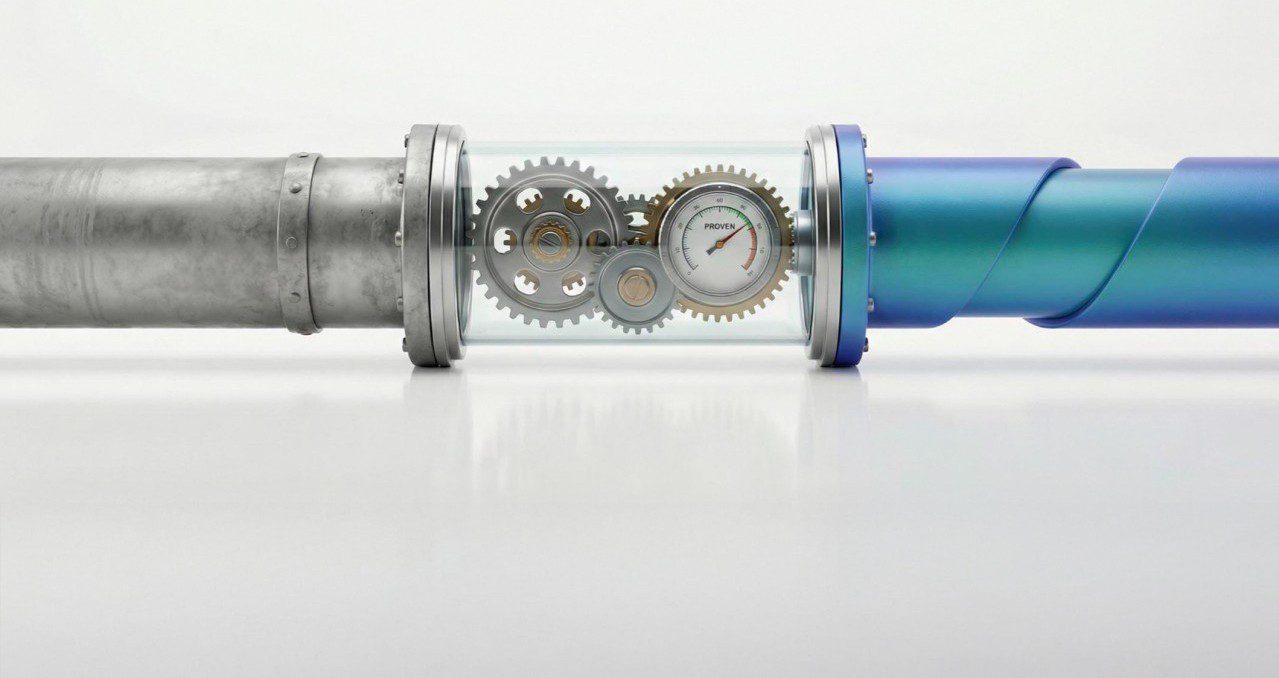
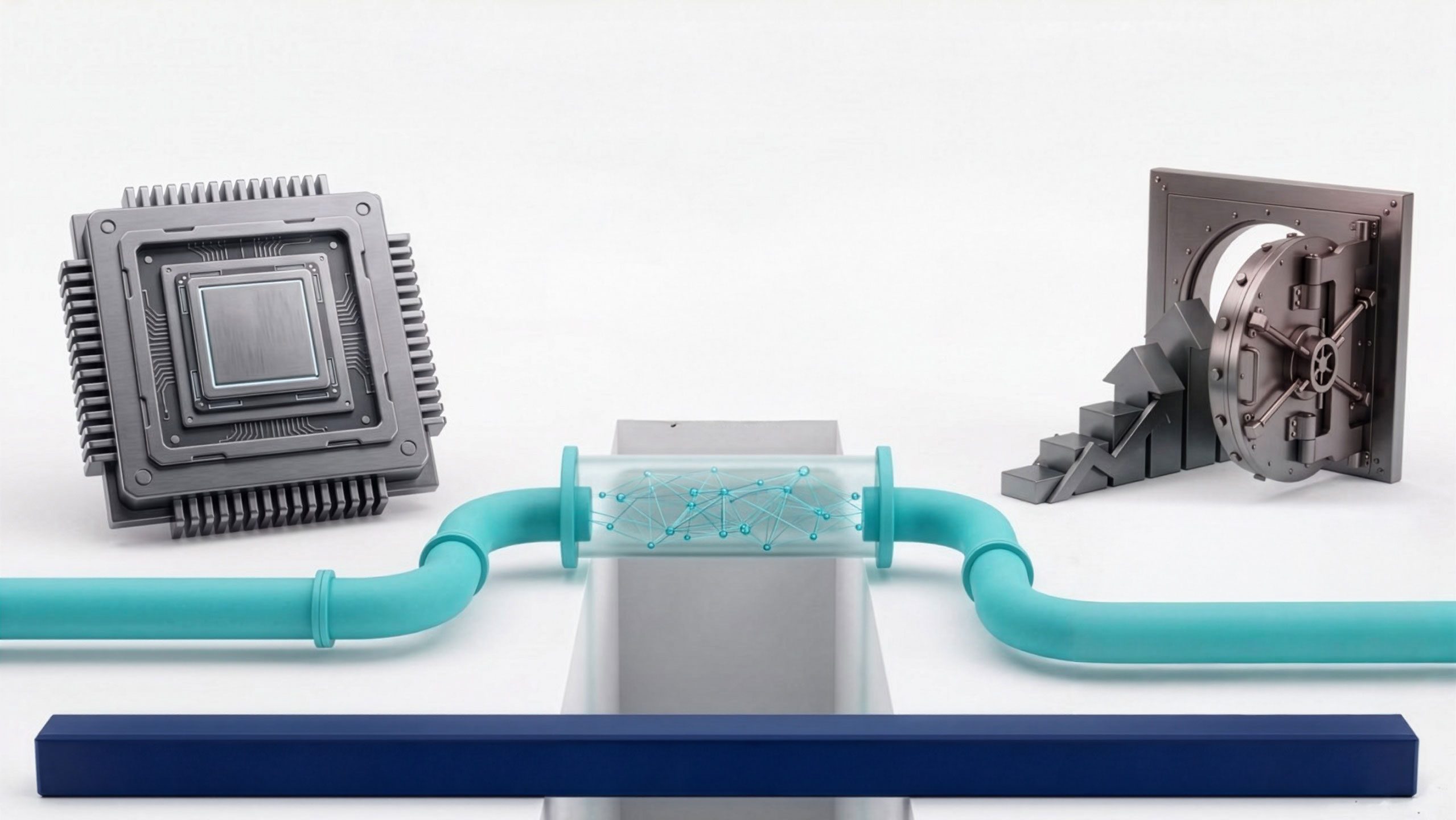
HFS coined the name for it. J.P. Morgan calls it AI's third phase. Business services becoming software.
What a service-centric business now is
A service-centric business used to be people. Then people and software. Now it is people, software and, increasingly, AI, running at the same time.
People hold the relationships, the judgement and the accountability. Software holds the workflow, the data and the system of record. AI holds a growing share of the execution.
The promise underneath it is specific. Services delivered as software get priced on outcomes, not hours, and growth stops being tied to headcount. HFS has a word for that. Non-linearity. Revenue and margin de-linked from the size of the workforce.
That is the prize everyone is quoting the trillions about. HFS sizes it at $1.5 trillion by 2035. J.P. Morgan puts the opportunity higher, $3 to 5 trillion, citing Vista and Bain. The houses do not agree on the size. They agree on the direction.
Why you cannot see it
Here is the strange part. A shift this large is happening quietly, inside businesses, without many noticing.
It does not arrive as an announcement. It arrives as noise that looks ordinary. The AI bill creeping up. A tool the team started leaning on. A client asking, at the last renewal, what the service actually changed for them. Each one looks like a small operational fact. None of them looks like the ground moving.
You cannot see a shift you have no instrument to measure.
The dream that failed for twenty years
Here is what the headlines miss. Pricing services on outcomes has been the dream for twenty years. It failed, every time. Not because anyone doubted the logic. Because no one could prove what the service caused. Without proof, every outcome contract collapsed back into an argument about activity. Hours. Effort. Who did what.
So the dream waited for one thing. A way to prove the line from what you do to what the customer gets.
That proof now exists.
The proof is the key, not the prize
The proof is not the prize. It is the key. It is hard won, built from the inside on your own data. But a key changes nothing on its own. What matters is the door it opens.
The prize is what the proof lets you build. A business where every part points at one customer outcome. The people, the software, the AI, the incentives, the decisions, the spend. All judged by the outcome they produced. All re-engineered against it, contract by contract.
That is Outcome Engineering. Not a tool. An operating model. And it is the moat, because a competitor cannot buy it, copy it or lift it off a shelf. It is built from the inside, and it compounds. 🎯
Two moats from one capability
Align the business this way and two things follow.
Facing the customer, you can show the line from your service to their result, so the contract reprices on the outcome. A cheaper day rate cannot dislodge you, because a competitor cannot show that line.
Facing inward, you see your own business for the first time. Which people moved the outcome. Which software did. Which slice of AI spend earned its place. So you automate what AI does better, move your people onto the judgement work, and cut the activity that produced nothing. That is how you reach the non-linearity, deliberately, against proof, not instinct.
And the inward one is the harder to copy. A rival can see your outcome-based contract and want one of their own. They cannot see inside your delivery, because they do not know which of their own inputs matter. They re-engineer in the dark. You re-engineer against proof. The gap widens with every cycle.
What it does to enterprise value
Two levers, one capability. Price rises, because you charge for the outcome and defend the premium at renewal. Margin rises, structurally, because every pound sits next to what it produced. Both turns of the multiple.
Where this leaves you
The wave is not in doubt. Business services are becoming software, and the AI that powers it will be on a shelf for every competitor by next quarter. The technology is not the moat. It never was. The proof is not the moat either. It is the key.
The moat is a business aligned to the outcomes it can prove. That is the one thing the trillions cannot buy.
Is your business aligned to the outcomes that matter?
Or is it still organised around the activity you hope adds up to one?