$1.5 billion. To close the implementation gap.
Last week Anthropic, Blackstone, Hellman & Friedman and Goldman Sachs officially launched a company called Ode. A hundred engineers. A Claude-first principle. An ambition, from CEO Chris Taylor, that is hard to ignore: “It’s pretty easy to imagine this as a trillion-dollar company someday if we execute well.”
A trillion-dollar company. Not to build the model. To make the model land inside a business.
That is the implementation gap. And Ode is betting everything on closing it.
They are right to. The implementation gap is real, expensive, and poorly served. But there is a second gap that nobody in that $1.5 billion consortium has yet named. And for every PE-backed and founder-led service business sitting between the model and the result, it is the one that costs multiples.
What Ode is actually doing
Blackstone conceived Ode because it kept hiring consultants and AI boutiques to deploy AI across its portfolio companies, and the results were inconsistent. One boutique, Fractional AI, stood out. So the joint venture acquired it and built Ode on top.
The model is forward-deployed engineering. Ode embeds elite applied AI engineers directly inside client organisations to identify where AI can have the greatest impact and build the systems that deliver it. Taylor is specific about who they work with: the CEO, on the top one or two priorities the business will execute over the next two years.
Eddie Siegel, Ode’s CTO and Fractional co-founder, is direct about what matters and what does not.
“I think model selection matters, but it’s not where the majority of calories are spent. It’s one ingredient in a system that has to be engineered. It’s like the choice of programming language when you build a piece of software. I would not define an enterprise transformation in terms of whether they choose Python or Java.”
Eddie Siegel, CTO, Ode with Anthropic — TechCrunch, 15 July 2026
One ingredient. The calories go into engineering the system.
That is the right framing for implementation. Siegel is correct. And Ode will solve real problems for the businesses it works with.
But implementation is not attribution. And that distinction is where the next gap begins.
The gap after Ode
Twelve months after Ode’s engineers have embedded, built, and shipped. The AI is running. The system is live. The CEO who owned the initiative is sitting in a portfolio review.
The PE operating partner across the table asks one question.
What is the business impact?
Not: is it working? Not: is the system live? Not: are the engineers happy with the quality?
How have you evidenced the outcomes that matter to the business?
That is not an implementation question. No amount of forward-deployed engineering answers it. Ode can build a system that runs flawlessly and still leave the CEO unable to answer it. Because the question is not about the technology. It is about separating what the intervention caused from what the market, the team, the client’s own decisions, and the passage of time produced anyway.
That gap, the distance between what a business can implement and what it can prove it caused, is the Attribution Gap. It is the most commercially consequential gap in the current AI economy, and it is entirely unoccupied.
Why this matters at the exact moment it does
The PE firms funnelling clients to Ode are the same firms under the most acute financial pressure the sector has seen in a decade. Debt costs 8 to 9 per cent. The multiple expansion that used to carry returns is gone. 71% of PE exit value in 2024 came from operational revenue growth. DPI, cash actually returned, has overtaken paper IRR as the metric that decides which firms survive.
In that environment, every AI initiative in every portfolio company is going to face the same question at exit. Not: did you implement AI? Every buyer assumes you have. The question is: what is the business impact? And can you evidence it?
A portfolio company that cannot answer that question is selling a story. A portfolio company that can answer it is selling evidence. Those are different assets. They command different multiples.
“Leaders in tech services who can evidence business outcomes command revenue multiples 3 to 3.5 times higher than those who cannot.”
Bain, November 2025
The ingredient nobody is supplying
Here is what is striking about the Ode story. In TechCrunch’s exclusive interview, Taylor describes the founding belief behind the venture: that “non-AI companies are going to be among the big winners of this whole AI moment if they adopt the technology the right way.”
Adopt the technology the right way. That is implementation.
But adoption without attribution is incomplete. A business that has adopted the technology the right way and cannot prove what it caused has implemented without evidencing. It has spent the calories on engineering the system. It has not spent the calories on establishing what the system moved.
Ode closes the implementation gap. The attribution gap is the next one. And for every PE-backed service business that will face a board, a renewal, or an exit conversation in the next three years, it is the gap that determines the multiple.
This is not theory
The proof already exists.
A managed services business proved one 300-seat contract was worth far more than it was charging. Same seats. Same technology. No new headcount. Gross profit moved from £75,600 to £184,350. A 144% increase. Margin from 30% to 46%.
The work did not change. The implementation did not change. The proof changed.
For a PE operating partner reviewing that number, the question is not what happened to gross profit. The question is what happened to the exit multiple on a business that can now evidence that outcome, contract by contract, at the data room stage. That is a different asset from one that cannot.
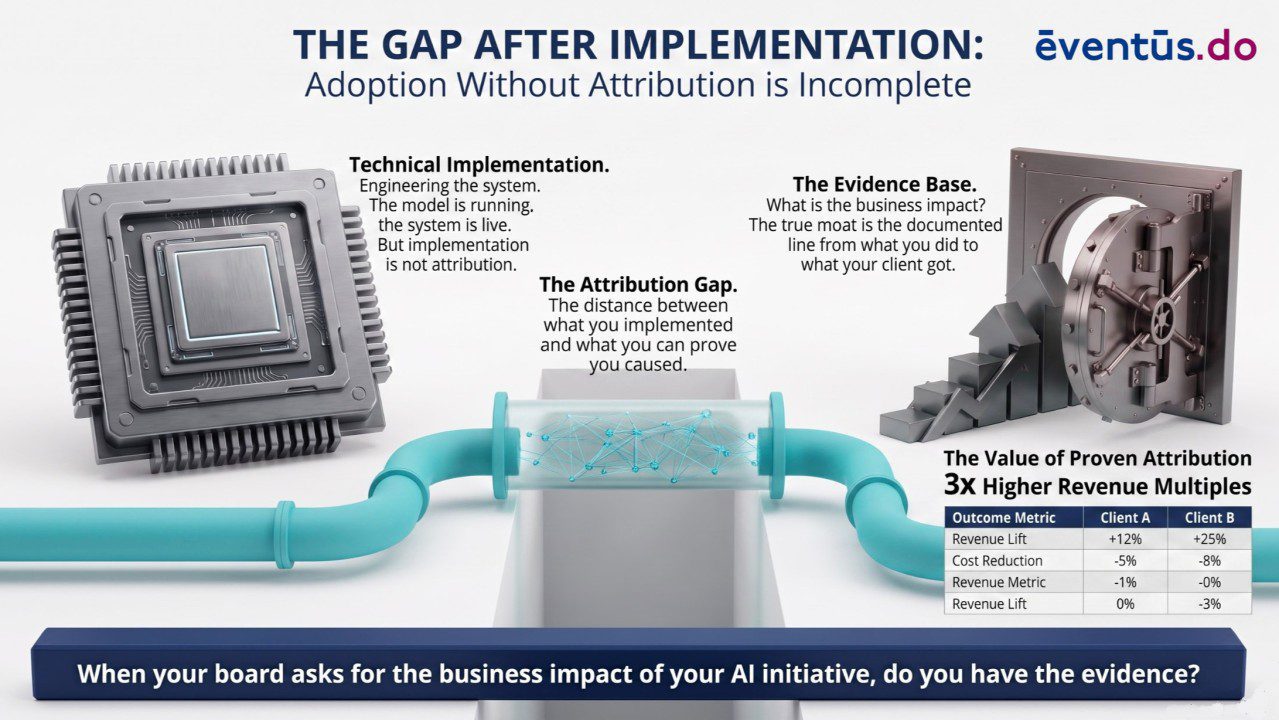
The moat is not the model. It is not the implementation. It is the proof.
Every competitor has access to the same models. Within the next two years, many will have access to the same implementation capability that Ode is building. The trillion-dollar bet confirms the direction. It does not create a moat for the businesses that rely on it.
The moat, the position that compounds over time and cannot be bought off a shelf, is the evidence base. The documented line from what you did to what your client’s business got. Proven, on your own data, contract by contract, renewal by renewal.
ēventūs.do establishes what the system caused. Ode’s engineers build the system. One builds the ingredient. The other proves what it changed.
The $1.5 billion confirms the market is moving in the right direction. The gap after Ode is where the real commercial prize sits.
When your PE board asks what the business impact of the AI initiative has been, and not whether it was implemented, how will your business evidence the outcomes that matter?
Originally posted on LinkedIn as part of our Outcome Engineering Newsletter: The Gap After Ode