Markets are challenging for PE. Holding periods have moved past six years, the longest on record, the number of PE-backed businesses in Europe is now 2.3 times those on the public market, and the IPO window is almost shut, figures PitchBook reported last week.
The old mechanism, financial engineering, no longer does the work it once did. And on top of that, PitchBook's US survey puts AI among the top three factors disrupting business investment.
Put those together and what every party now needs is confidence. Confidence for the LP that the return is real. Confidence for a buyer that the value will hold, before they pay for it. Confidence for the firm that its capital is going where it works.
Confidence is what unlocks the next investment, the next purchase, the higher multiple, and in a market this uncertain it is scarce. Confidence is not won by asserting value. It is won by evidencing it, by proving how a business is driving results for its customers.
Evidence cannot be argued with, and that is what gives LPs and the market confidence. That proof does two things at once. It accelerates performance, because the business focuses on what works rather than on activity. And it re-rates the multiple, because a buyer pays more for value that is proven than for value that is claimed. Same business, more confidence, a higher price.
For years this was the gap no one could close. Firms could create the value but not evidence the line from what they did to the outcome the customer got. Now, they can.
The opportunity is already in the business
The opportunity is closer than it looks. It sits in the services and contracts the business already delivers today. It does not depend on new logos or added capacity. It is operational value creation: growing the value of the work already being done, through the way the business is led and run. For a service-centric business, the question is how that value is grown. Not by scaling activity, more heads, more billable hours, at a price AI is driving down. It is grown by proving the value the business already creates for its customers, which is also what wins and keeps the next contract.
This is the shift from value in exchange to value in use. Value in exchange is priced on inputs, the hours, the seats, the effort, what the business does. Value in use is the worth the customer realises, the outcomes they care about. AI is collapsing the price of inputs, so value in exchange is trending to zero. The value that holds is value in use, and it can only be charged for, defended at renewal and rated by a buyer when the outcomes that matter to the customer are evidenced.
So the durable value is operational and proven: showing which interventions drive the outcomes the customer cares about, and the margin, retention and revenue that follow, from the data the business already holds.
When activity gets cheap, people move up
When AI makes the activity cheap, value moves to the thing AI cannot do, which is evidencing what the service caused for the customer, in their numbers.
That is where people move up. Off the work the tool now handles, and onto owning the outcome and engineering the business against it. It is not a threat to the operator. It is a promotion.
The method exists, and it is here
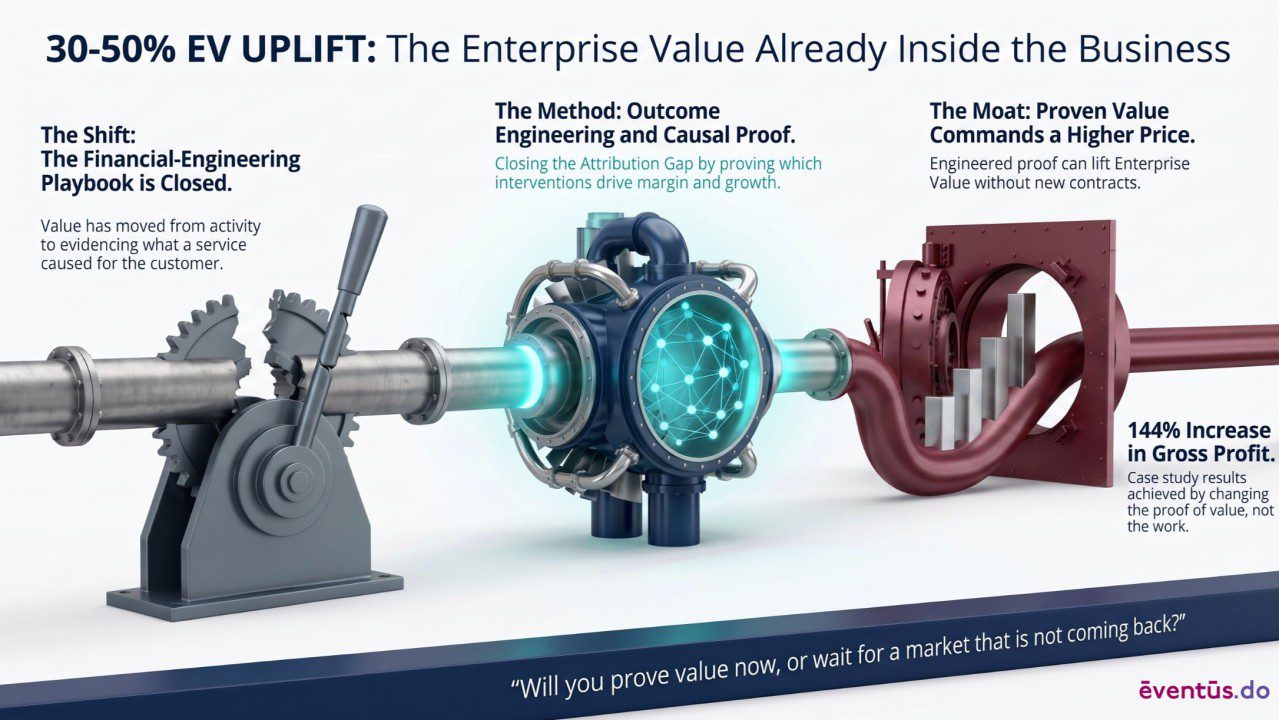
There is a name for doing this, and it is the heart of it: Outcome Engineering. It is how a business evidences value creation, by closing the Attribution Gap.
The Attribution Gap is the mechanic. Most service-centric businesses cannot yet evidence which of their interventions drove which customer outcome, so the value they create stays invisible. Close the gap and the line from what the business did to the outcome the customer got becomes provable. That is the whole game.
Outcome Engineering harnesses AI and advanced technology against the business need and the outcomes they can drive, then evidences the improvement at every step, all the way to a transaction. It is not theory and it is not a slogan. It exists, it is proven, and it is here. 🎯
What it looks like in real money
This is not hypothetical. One service-centric business we work with had a 300-seat managed services contract running on the standard model. Cost-plus pricing. 30 per cent gross margin. Gross profit of £75,600 a year.
Nothing wrong with the work. The customer was happy. Every service level was met. They did not win a new logo, they did not hire, and they did not change the technology.
What they did was build the line. From the operational work they were already doing, using the data already in the business, to the outcomes the customer cared about. They evidenced what their service had caused. The customer agreed, and the contract repriced on the outcome.
Gross profit on that same contract moved from £75,600 to £184,350. A 144 per cent increase. Margin moved from 30 per cent to 46 per cent. A rolling annual contract became a three-year term.
The work did not change. The proof changed. That is operational value creation, on an asset already owned, with nothing bought and no one hired.
Now read that at portfolio level. Service-centric businesses that lift net revenue retention above 120 per cent command valuation multiples 30 to 50 per cent higher than peers stuck at 100, on the same revenue. The operational gains evidenced inside the hold become the enterprise value realised at exit. That is confidence re-rating the multiple, and that is where the 30 to 50 per cent comes from.
The moat, and the power it gives
Evidenced outcomes do more than lift a single contract. They build a moat. A competitor can copy a service, but it cannot copy years of proof that the service caused specific results for the customer. That record belongs to one provider, and it compounds with every renewal.
It also shifts the power in the relationship. When the customer holds the evidence of what the service produced, leaving means losing it, so the conversation stops being about price. The provider sets the terms, because the value is undeniable.
From there the numbers follow. Revenue grows, because customers pay for the outcomes they achieve. Pricing gains elasticity, because it is anchored to value, not to hours. Contracts lengthen, because the proof is worth keeping. And enterprise value lifts, because every pound of it is evidenced rather than asserted.
Why this is the opportunity, not the threat
The financial-engineering era rewarded timing the market. This one rewards building the business and proving it. That is the harder skill and the more durable one, because evidenced value cannot be competed away on price or undone by a cold IPO market. It is banked, contract by contract, and it holds at exit.
The firms that treat the longer hold as a problem will wait for a window that may not open on their timetable. The firms that treat it as the time to build will reach the exit with a business priced on proof, and the confidence that earns a higher multiple.
So, a fair question to end on. You are already creating value inside the businesses you own. The long hold is the time to evidence it. Will you spend it proving the value you have created?
Originally posted on LinkedIn: https://www.linkedin.com/pulse/30-50-ev-uplift-outcome-led-premium-george-davies-vgzte/