Reuters reported it in February 2026. India's IT-services sector lost around $40 billion in market value in seven days.
Not on a profit warning. On a fear.
The fear was simple. That AI would erode a model built on people and billable hours. TCS, one of the giants, reports roughly $1.8 billion of AI-services revenue. The market looked at the listed leaders, weighed how durable the model really is, and marked it down in public.
That is the market doing the maths out loud.
It does not stop at the giants
The selloff was about listed companies. Your business is not listed. So it can feel like someone else's problem.
It is not.
If the market marks down a multi-billion firm on the durability of its model, a £20 million service-centric business gets marked down on the same logic the moment a buyer sits across the table. The headline is the giants. The application is you.
In the buyer's chair, every unknown is a deduction
A buyer does not pay for what you did. They pay for what they believe will keep happening after they own it.
So they look for two things that frighten them.
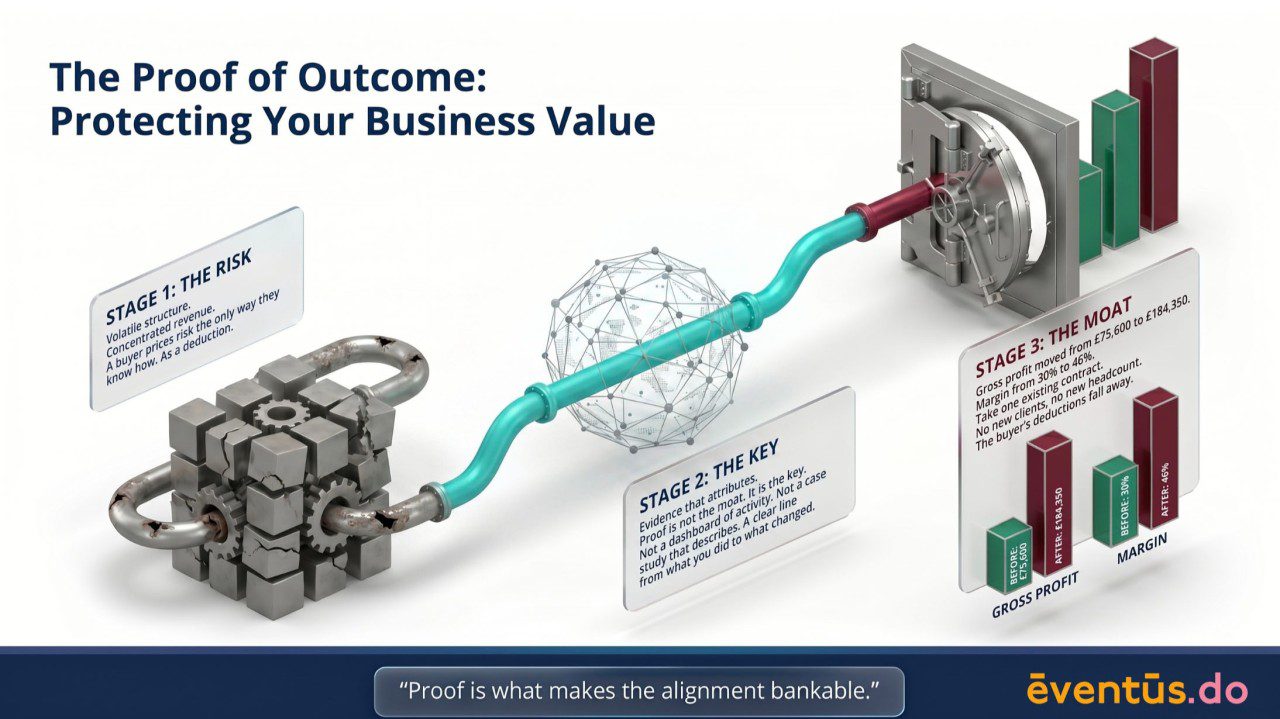
Volatile structure. Revenue that moves with effort, headcount and hours, not with a contracted outcome.
Concentrated revenue. Too much of the result sitting with one client, or one founder who is the only person who can explain why the client stays.
Both are risks. And a buyer prices risk the only way they know how. As a deduction. Every answer you cannot evidence comes off the multiple before you have finished the sentence.
What removes the deduction
There is one thing that removes it.
Proof. The ability to show that your service produced the customer's outcome, with a clear line from what you did to what changed. Not a dashboard of activity. Not a case study that describes. Evidence that attributes. 🎯
Take one existing contract. No new clients, no new headcount. Gross profit moved from £75,600 to £184,350. Margin from 30% to 46%. The work did not change. The proof of what the work produced did, and the price followed it.
That is what removes the deduction in practice. When you can prove it, outcome-led pricing becomes possible, because you can charge for a result you can stand behind. Retention rises. Margin quality rises. The revenue stops looking volatile and starts looking contracted. The buyer's deductions fall away, one at a time.
Simon-Kucher's work on outcome-led commercial models makes the mechanism plain. Pricing tied to evidenced outcomes lifts retention and lifetime value, the exact inputs a buyer uses to set the multiple.
Proof is the instrument, not the prize
Here is the part most people miss.
Proof is not the moat. It is the key.
The moat is the whole business aligned to a defined customer outcome. People, software, AI, incentives and pricing, all pointed at the same result, and re-engineered against it as it moves. A competitor can buy the same AI off a shelf by next quarter. They cannot buy that.
Proof is what makes the alignment bankable. It is the instrument that turns "we deliver value" into a number a buyer will pay for.
The close
So the question is not whether your last project went well.
It is the one the buyer is already asking. If they sat across from you today and asked you to prove your service drove your client's results, what would you put on the table?
Originally posted on LinkedIn: https://www.linkedin.com/pulse/40-billion-gone-week-buyer-already-doing-maths-george-davies-ilnpe/