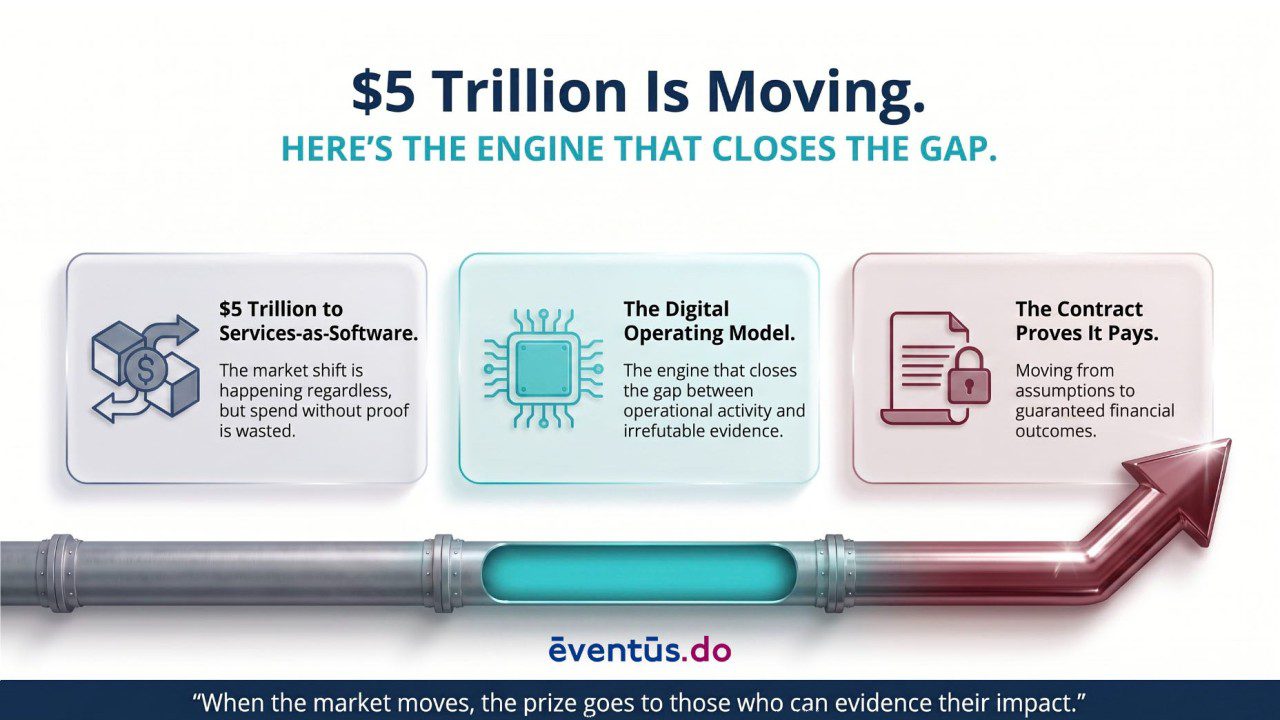
HFS and J.P. Morgan size the Services-as-Software shift at $1.5 to $5 trillion. That money is moving regardless of what any single business does about it.
Peter Bendor-Samuel, founder of Everest Group, writing in Forbes this week, confirms where it is going. Software and services, he argues, are merging into one thing. The forty-year separation between the platform you buy and the people who make it work is ending.
What he is describing
For decades, software firms sold a standardised product and services firms sold adaptation around it, two different businesses, kept apart on purpose. Bendor-Samuel’s case is that agentic AI ends the separation. These platforms are dynamic, deeply customised to each business, with expertise built directly into the technology itself. His conclusion: business outcomes, not products or labour, become the organising principle of enterprise technology.
Read that back. An analyst with no connection to Outcome Engineering has just described the model, software and services combined, organised around the customer’s outcome, not the seat or the hour. This is not a shift you need to prepare for. It is a shift a leading analyst says has already started.
The question he does not ask
Here is the gap in the argument. If outcomes are the organising principle, how do you know you are hitting them? Bendor-Samuel describes the destination and stops. Outcome-led without proof is not a model. It is a claim.
That gap is not theoretical, and it is not cheap. Uber’s own COO admitted publicly that the business cannot draw a line between its AI investment and any measurable result, after the company burned through its entire 2026 AI budget in four months. And Uber is not the exception. In a PwC survey of over 4,000 chief executives, 56 per cent reported no revenue or cost benefit from their AI investment at all.
One of the best-resourced engineering organisations on the planet has the activity data and cannot connect it to an outcome.
The engine that closes the gap
Bendor-Samuel describes agentic platforms built on ontologies and digital twins, systems that observe, predict and act. Strip the language back and what he is pointing at is a live model of the business.
That is what closes his gap. Not a static org chart or a slide of processes, a digital operating model, a working map of cause and effect that connects what you do to what happens to the outcomes that matter to the customer. Which lever moved the outcome. Which did not. Once you can see that, you stop guessing at the people, software and AI mix and start setting it deliberately, against what the model shows you, not instinct.
That model is also what makes the outcome defensible. It is not a report you show once. It runs continuously, so the proof updates as the business does.
Where the proof already exists
This is not a new problem for a service-centric business, it is the same one you solve today. A managed services business engineered a single 300-seat contract around the outcomes that matter to its customer, then proved what the change was worth. Same seats. Same customer. Gross profit moved from £75,600 to £184,350. A 144 per cent increase. Margin from 30 per cent to 46.
That is the difference between describing the shift and running on it. The businesses that can evidence their impact on the outcomes that matter to the customer are the ones for whom this shift is already paying, in repriced contracts, in retention, in a multiple a buyer will defend.
So, one question. Bendor-Samuel says the model has arrived. Can you evidence your impact on the outcomes that matter to your customer, or are you still describing what you did?