There is one number in your business that determines everything else at exit.
Not revenue. Not EBITDA. Not growth rate.
Net Revenue Retention.
How much of your existing client base stays, expands, and grows — without winning a single new customer.
Before we get to the numbers, a word on the data
NRR originated in SaaS. The valuation data here comes from SaaS M&A research because that is where it is most precisely documented.
But the dynamic NRR measures exists in every service-centric business.
A managed services firm. A cyber services provider. A contact centre operator. A financial services business. All of them have a revenue base that renews, expands, or erodes each year. The question of how much of last year's revenue survives and grows is the same question in every service model.
The valuation consequence is the same too.
What the SaaSpocalypse revealed
In February 2026 the SaaS market repriced sharply. The SaaS Capital Index fell from 7.0x to approximately 3.8x. Roughly £1 trillion in aggregate market capitalisation wiped in weeks.
But something important happened beneath the headline.
The gap between businesses with provable retention and those without did not compress.
It widened.
Top-quartile companies with NRR above 120% maintained premium valuations while the median fell. Buyers became more disciplined. The premium for evidenced retention actually increased.
The three tiers
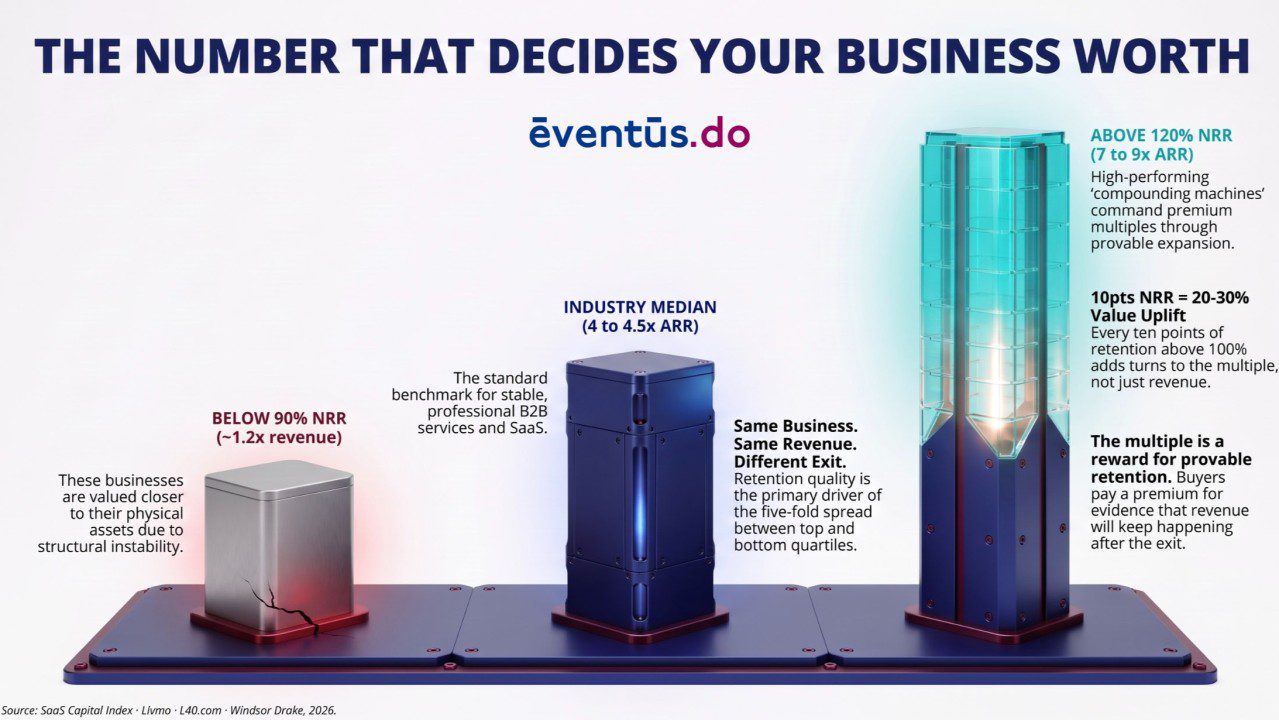
Below 90% NRR — approximately 1.2x revenue. The cliff edge. Repriced toward asset value. Every renewal is at risk.
Industry median post-repricing — 4 to 4.5x ARR. Compressed from pre-2026 levels. Holding position.
Above 120% NRR — 7 to 9x ARR. Premium held through the correction. The gap with the median has never been wider.
Three businesses. Identical revenue. Wildly different enterprise values.
The multiple is not a reward for good service. It is a reward for provable retention.
What drives NRR
One thing above all others.
Whether your clients can see the value you are delivering to their business.
When a client can see it, renewal is not a negotiation. It becomes a conversation about what to do next. Expansion is not a pitch. It becomes a logical extension of proven value.
When a client cannot see it, every renewal defaults to price. The relationship erodes not because the service is poor but because the value is invisible to the people who control the budget.
"Companies with structured, outcome-based client conversations produce NRR seven percentage points higher than peers with basic practices." McKinsey, 2025–26
This is not a pricing problem. Not a technology problem. Not a product problem.
It is a proof problem.
The Attribution Gap
Most service-centric businesses are already delivering value. The service is working. The clients are staying.
But when the renewal conversation arrives, or the PE board asks what the AI initiative actually moved, or the exit process begins and a buyer asks what is defensible in the revenue base — the same gap opens.
The Attribution Gap.
The distance between what you delivered and the value you can prove you caused.
Most businesses live in this gap permanently. They have the data. They do not have the evidenced line connecting what their service did to what their client's business got.
The SaaSpocalypse made this gap more expensive. When buyers become more disciplined, the discount applied to businesses that cannot evidence their value gets steeper.
Provable retention is now the floor, not a premium.
What the gap costs
Gartner forecasts 40% of enterprise contracts will include outcome-based elements by 2026, up from 15% two years ago. But the Institute of Product Management finds only 17% of businesses running true outcome pricing.
The adoption curve is steepening faster than the measurement infrastructure is being built.
The window
Three signals are converging.
Anthropic and Blackstone launched Ode in July 2026 — a £1.5 billion joint venture to embed engineers inside businesses to implement AI and measure its impact. Their chief technologist says the model is one ingredient. The calories go into the system around it.
Salesforce paid £3.6 billion for Intercom's Fin in June 2026. An AI agent priced on the outcome layer, not the model underneath.
ICLG forecasts 30% of IT service contracts will be outcome-based by 2029. The time-and-materials model is being written out of procurement frameworks.
The market is moving faster than the measurement infrastructure.
The proof already exists
A managed services business restructured a single 300-seat contract around evidenced outcomes.
Gross profit moved from £75,600 to £184,350. A 144% increase. Same client. Same seats. No new technology.
NRR moved from below 100% to above 115%. The contract extended from rolling annual to three years.
The client paid more because the impact on their business performance was visible, evidenced, and commercially undeniable.
The only thing that changed was proof.
Outcome Engineering
Outcome Engineering is the commercial discipline of closing the Attribution Gap.
It connects what a service-centric business delivers to what its clients achieve. It produces evidence that is specific, financial, and commercially defensible at renewal, in a tender, and at the data room stage.
It is not a technology proposition. It is not a consulting methodology. It is the infrastructure that makes the value you are already creating visible to the people who need to see it.
The NRR data, even after repricing, shows precisely what that proof is worth.
Below 90% NRR: 1.2x revenue. Industry median post-repricing: 4 to 4.5x ARR. Above 120% NRR: 7 to 9x ARR — premium held through the SaaSpocalypse.
The Attribution Gap is the distance between those numbers. Outcome Engineering is what closes it.
Where does your business sit on the Net Revenue Retention scale? And do you have the attribution infrastructure to move it?
ēventūs.do applies Outcome Engineering to close the Attribution Gap, moving service-centric businesses from activity reporting to evidenced impact, contract by contract, renewal by renewal.
Take the Outcome-Led Readiness Assessment. Eight questions. Three minutes. Your score shows where you are across seven readiness drivers and your priority next move.
[email protected] | eventus.do
#founder #ceo #privateequity #outcomes #ManagedServices Sources
Valuation data — post-SaaSpocalypse repricing
• SaaS Capital Index, 2026: median public SaaS ARR multiple fell from 7.0x (January 2025) to 3.8x (March 2026) following the SaaSpocalypse repricing event.
• Fungies.io, SaaS Valuations 2026: post-SaaSpocalypse median private B2B SaaS at 4.5x ARR; NRR above 120% with Rule of 40 above 50 commands 7–9x ARR.
• Livmo, SaaS Valuation Multiples 2026: NRR above 120% closes at 7–9x ARR in private transactions post-repricing. livmo.com
• L40.com, SaaS Multiples June 2026: companies with NRR above 120% and Rule of 40 above 50 reach 7–9x. l40.com
• SaaSRise, SaaS M&A Report 2026: premium valuation formula post-SaaSpocalypse: Rule of 40 above 50 plus NRR above 120% equals 7–9x ARR. saasrise.com
• Windsor Drake, SaaS Valuation Multiples 2026: NRR below 90% trades near 1.2x revenue; above 120% commands 8x+. windsordrake.com
• FE International, NRR and SaaS Valuation 2026: below 90% approximately 1.2x revenue. feinternational.com
Attribution and outcome-based pricing
• McKinsey, 2025–26: structured outcome-based client conversations produce NRR seven percentage points higher than peers.
• Monetizely, citing McKinsey, 2026: weak attribution drives approximately 15% overpayment on performance-based contracts.
• Monetizely, citing Gartner, 2026: 40% of enterprise contracts will include outcome-based elements by 2026, up from 15% two years prior.
• Institute of Product Management, 2026: only 17% of businesses run true outcome pricing despite market demand.
• Ibbaka, B2B SaaS and Agentic AI Pricing Predictions 2026: the attribution problem is not widely acknowledged by pricing experts, mostly because they do not see a way to solve it. ibbaka.com
Market signals
• TechCrunch, Rebecca Bellan, 15 July 2026: Anthropic and Blackstone launch Ode, $1.5 billion joint venture for AI implementation inside enterprise clients.
• CNBC, 15 June 2026: Salesforce acquires Intercom Fin for $3.6 billion.
• ICLG Technology Sourcing Report 2025–26: 30% of IT service contracts to be outcome-based by 2029.
© 2026 ēventūs.do Ltd. All rights reserved. This article may be shared freely provided authorship and source are credited.