The Ones That Do Not, Re-Rate The Multiple By Up To 60%. Why?
Ricky Asemota is a Partner at McKinsey. This week he said something on LinkedIn that explains the whole problem in one line.
The operators who can evidence it wrote down the counterfactual at entry, before the plan met the market. Nobody can reconstruct that at exit.
Here is what that means, in plain words.
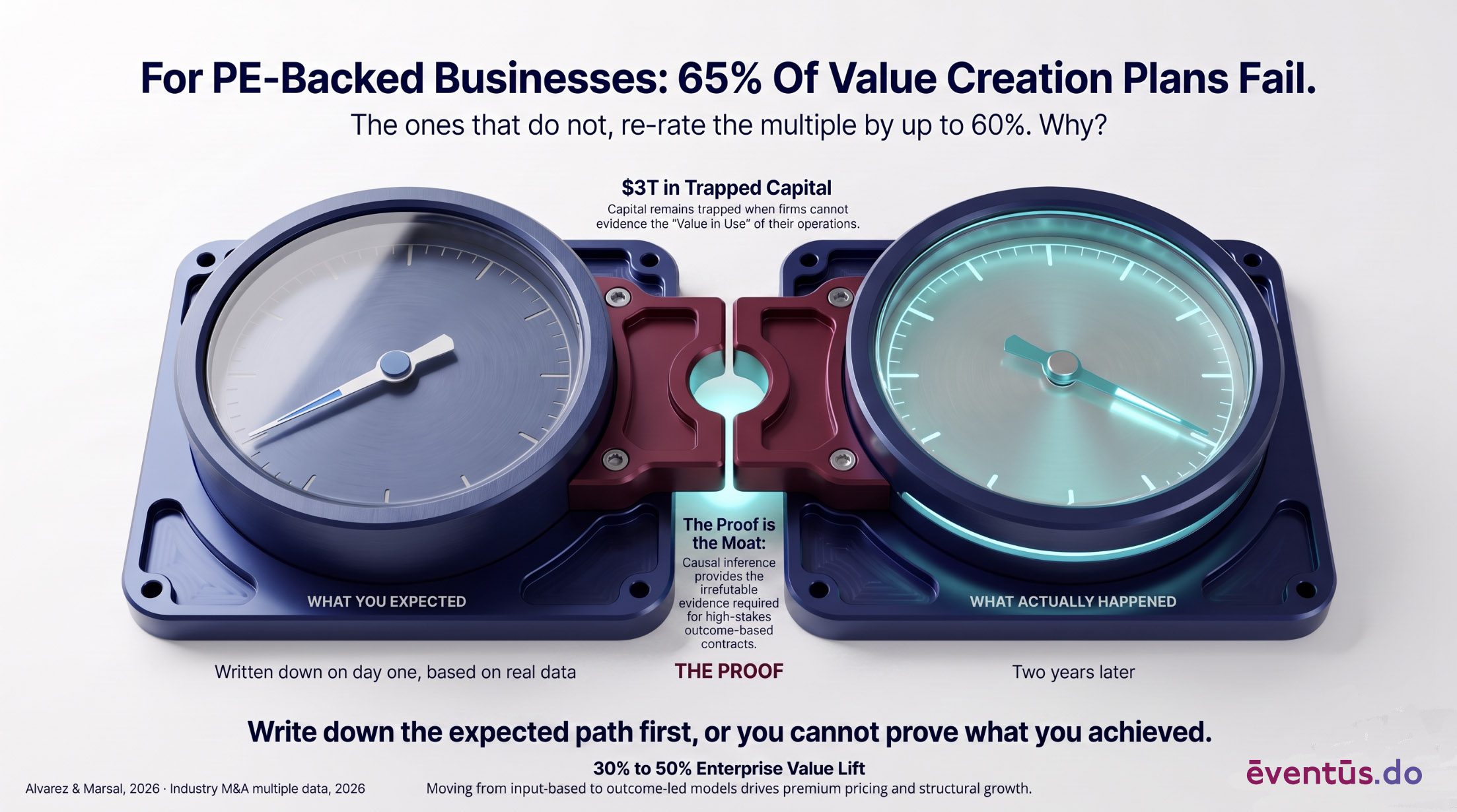
Before you change anything in a business, guess what would happen to it if you left it alone. Write that guess down. Two years later, look at what actually happened, and compare it to your guess. The difference between the two is what you actually did.
If you never write down that guess, you cannot do this later. Too much has happened by then. You cannot untangle what you did from what would have happened anyway.
Here is why that matters. You cannot fairly charge more for a business unless you can prove what you did to it.
A buyer will only pay extra for growth if they believe it is real and it was caused by something specific, not luck or the market being good. When a business can prove what it did, it sells for more. When it cannot, buyers assume the worst and pay less. Same business, same profit, sold for nearly double depending on whether the seller can prove what caused the growth.
If you cannot show what you did, the buyer cannot tell either. So they knock the price down instead of paying more.
Before you change anything in a business, work out what would probably happen to it if you left it alone. Base that on real numbers, past performance, what similar businesses have done, market conditions, not a hunch. Write that expected path down.
Two years later, look at what actually happened, and compare it to what you expected. The difference between the two is what you actually did.
Most plans fail, and it is not because the wrong things were tried
Something has changed in how businesses grow in value. It used to come mostly from selling more. Now it comes mostly from running the business better. That flipped for the first time recently.
Everyone running these businesses has been told the same thing. Make the business run better. Fix pricing, cut waste, sell smarter.
So they try. And most of the time, it does not work as well as promised. Most plans to improve a business only get halfway to their goal.
That is not because they picked the wrong things to fix. It is because of one thing nobody did on day one.
Most people do half the job
Most people now know to write down what the business looked like before they started. What it earned, how many customers left, all of that.
That is good. It is not enough.
Writing down where you started only tells you the beginning. It does not tell you what would have happened anyway if you had done nothing. Markets change on their own. Teams get better on their own. Some of the improvement would have happened even without you.
Knowing where you started is not the same as knowing what you actually caused.
This has to happen before you start, not after
Before you touch the business, you need an honest guess. Not just where it is now. Where it was already heading, on its own, if nothing changed.
Write that guess down while it is still fresh and honest. Later, you can compare what really happened to your guess, and the gap between them is what you can honestly say you did.
Skip that step, and by the time anyone asks, it is too late. Too much has happened. The market moved, the team worked hard, five things changed at once, and nobody can honestly say which part was you.
Write it down first, or you will never be able to prove it.
This is not about measuring better. It is about planning better
Most people think the problem is measuring things properly. It is not.
The problem is that the plan was never built to be checked in the first place.
The plans that hold up were built with this in mind from day one. What the business looked like at the start. What would have happened without any changes. What the plan was actually trying to achieve. All written down before anyone touched anything.
The plans that fall apart were written to tell people what to do. Nobody thought about how to prove it worked until a buyer asked.
What it looks like when this is done properly
One business. A contract to run IT support for 300 people. Before anything changed, someone wrote down what the contract was earning, and what it would probably keep earning if nothing changed.
Two years later, the profit on that one contract had gone from £75,600 to £184,350.
Because someone had written down the starting guess, that increase could be clearly shown as the result of the changes made, not just the market being kind or the client growing on its own.
The contract, which used to renew every year, moved to a three-year deal. The client paid more, because the number in front of them was not just a claim. It was proof.
The question
Ricky said it well. Decide what would happen without you, before you start. Not after. By the time you get to the end, that starting guess is gone, and you cannot get it back.
You can only fairly ask for more money if the buyer believes your number. And they will only believe it if you can show your working from day one.
That is the whole idea. Prove it before you start, not after.
So here is a question for anyone who has lived this. Have you seen a business improve, but the people running it could not prove what they actually did? What happened?
I have my own view. I would rather hear yours.
Sources
Alvarez & Marsal, fifth annual European Value Creation survey, May 2026: study of 240 private equity exits in Western Europe, 2013 to 2025. Profit improvement from running businesses better made up 51% of profit growth in businesses sold in 2025, up from 21.5% before 2023. 65% of improvement plans delivered less than half of what they promised.
The up to 60% price difference comes from comparing what similar businesses sell for. Businesses with proven, repeat revenue sell for 7 to 9 times profit. The same business with unproven revenue sells for 4 to 6 times profit. Taking the middle of each range, that is a 60% difference in price for identical profit (industry data, 2026; consensus across Bain, McKinsey, Lincoln International, GF Data).
Bain & Company, Global Private Equity Report 2026: businesses now need roughly 12% profit growth each year to deliver the same return that 5% used to.
Ricky Asemota, Partner, McKinsey, LinkedIn comment, August 2026.
ēventūs.do client data: a 300-seat managed services contract, profit up from £75,600 to £184,350, a 144% increase, contract term extended from one year to three.
ēventūs.do applies Outcome Engineering to evidence the impact on outcomes, moving service-centric businesses from activity reporting to evidenced impact, contract by contract, renewal by renewal. Accelerating business performance. Lifting Enterprise Value.
Take the Outcome-Led Readiness Assessment. Eight questions. Three minutes. Your score shows where you are across seven readiness drivers and your priority next move: https://eventus.do/what-we-do/readiness/